Liveaboard.com

Sullivan Bay Adventure Cruises

Our guests rated adventure cruises in Sullivan Bay as 9.3

  • 100% Best Price Guarantee
Sullivan Bay Adventure Cruises

Adventure Cruises in Sullivan Bay

Sullivan Bay on Santiago Island is renowned for its geological value to the scientific community and the tourists who visit it. It holds a special place in history as the second of the Galapagos Islands visited by Charles Darwin.

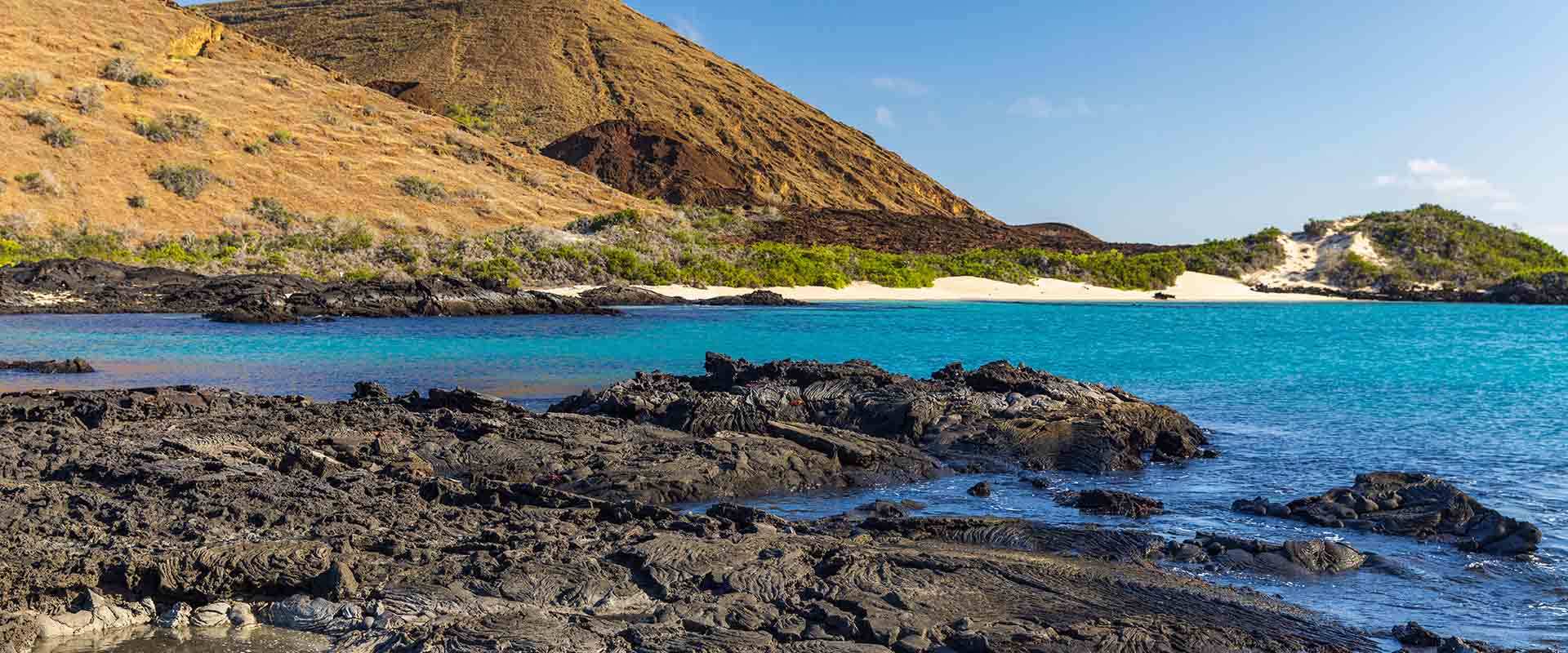
Guests are invited to walk the hour-and-a-half path from the visitor’s center through the bay to marvel at the volcanic landscape created by long cooled lava flows from 1897. The formations underfoot simulate the waves in the sea and join together in both rope-like structures and rusty colored tuff cones.

Wildlife encounters at Sullivan Bay include the usual suspects in Galapagos, including boobies, tropical fish, and reptiles for which the islands are famous. This site is prized primarily for its unusual appearance and landscape, however rather than abundant animal life.

The white sand beach is a glorious visual contrast to the edge of the lava stream it borders. No adventure cruise to Sullivan Bay would be complete without swimming or snorkeling in the clear blue Pacific waters.


Top things to do and see at Sullivan Bay

Most guests visit Sullivan Bay to see the landscape and take the hour and a half hike over the plumes and pahoehoes created by flowing lava so many years ago. Hikers will appreciate the local vegetation including Molluga plants and the incredible view of the volcano that made the island itself.

After the hike it’s time for a swim or snorkel in the lava cape at Sullivan Bay. The setting makes the perfect photograph with the blue water, white sand beach, and dark volcanic landscape.

Top Tips for visiting Sullivan Bay

  • To get the most out of your trip to Sullivan Bay, here are some helpful tips.
  • Be sure you have some sun protection like sunblock or clothing that covers your skin. It’s important to be able to limit your sun exposure as necessary.
  • You’ll want some sturdy, adequate shoes for walking or hiking around Sullivan Bay. Blisters are not a part of this vacation. Bring along some water shoes as well for snorkeling.
  • To capture your Sullivan Bay wildlife encounters or a visual keepsake of the bay itself, bring a camera along. If you want to use a mobile device off of the ship, we recommend you protect it with a water tight sleeve and a dry bag during transport.
  • Visitors who want to scuba dive will have access to complimentary tanks, weights, and belts. If you have other equipment for scuba like a mask, you can bring it along or rent whatever you need onboard.

Best time to cruise to Sullivan Bay

To plan ahead for your small ship cruise to Sullivan Bay it helps to understand the seasons in Galapagos. This way, you can pick perfect weather for snorkeling and other adventure activities like hiking.

Sullivan Bay in December through May experiences the warm or wet season. June through November is the dry season. Hiking is best in the warm season. There are long blocks of daily sun and the climate is warm and inviting. The dry season from June through November is prime snorkeling season in Sullivan Bay. The blue water is at its clearest and water temperatures are warm.

If a Sullivan Bay wildlife encounter is your travel wish, you’re in luck. The land and sea creatures that call Sullivan Bay home are present year round regardless of the season. The animals aren’t as plentiful as in some other areas of Galapagos, however. It may be helpful to know that the area’s Green Sea Turtles lay their eggs from January to March. The Blue Footed Boobies, on the other hand, mate in May.

Where do Sullivan Bay cruises depart from?

Galapagos Island adventure cruises to Sullivan Bay depart from ports in Baltra, Puerto Ayora, or San Cristobal. Your specific cruise itinerary will confirm your departure port.

First, you’ll arrive in either Quito or Guayaquil airports on Mainland Ecuador. Thereafter, you will fly domestic to the Galapagos Islands as directed by your cruise itinerary. Your guides will escort you and your luggage to the ship to begin your Sullivan Bay vacation.

Want to book your next adventure cruise to the Galapagos Islands? Contact our reservations team today.


Sullivan Bay Adventure cruise reviews

  • Rating 9.3 out of 10
  • 9.3 Superb
  • Rating 9.6 out of 10
  • 9.6 Exceptional
  • Peter S
  • Flag of United StatesUnited States

The lava field trail, which I did not walk, because at my age it was slightly difficult and I did not want to get hurt!

Cruising Sullivan Bay in February on the Bonita
  • Rating 10.0 out of 10
  • 10.0 Exceptional
  • Tanya R
  • Flag of United StatesUnited States

The lava flow and geological lesson was so interesting. We were witness to life reestablishing itself. Incredible.

Cruising Sullivan Bay in November on the Solaris
  • Rating 8.0 out of 10
  • 8.0 Very good
  • Roger B
  • Flag of United StatesUnited States

Hike was enjoyable. Lava river was worth seeing

Cruising Sullivan Bay in May on the EcoGalaxy
  • Rating 9.6 out of 10
  • 9.6 Exceptional
  • Rebecca B
  • Flag of United StatesUnited States

the Sullivan bay snorkel was one of the best and a great start to the trip

Cruising Sullivan Bay in October on the Endemic


What to know about adventure cruising in Sullivan Bay

When was the last eruption among the Galapagos Islands?

La Cumbre on Fernandina erupted most recently in March 2024, with lava reaching the southeast coast. The most-visited lava field, however, is Sullivan Bay on Santiago — from an 1897 eruption — which remains one of the freshest-looking landscapes a non-scientist can walk across.

Why are the Galapagos Islands geologically young?

The current visible islands are all less than 5 million years old, with new ones still forming on the western edge. Lava flows like those at Sullivan Bay, from just 1897, show how recently the landscape is still being built and reshaped.

Are the Galapagos Islands still volcanically active?

Yes — five of the western islands sit over an active hotspot, with eruptions on average every few years. Sullivan Bay's lava field from 1897 is one of the youngest fully cooled surfaces a visitor can walk across.

Where is the most recent volcanic activity in the Galapagos?

The most active sites are Fernandina (most recently 2024) and Wolf Volcano on northern Isabela (2022). For visitor-accessible lava, Sullivan Bay on Santiago is the showpiece — a vast pahoehoe field from a 1897 eruption that you can walk across.

What kinds of lava are visible in the Galapagos?

Both main types: rough, blocky "a'a" lava is common on Isabela's volcanoes, while smooth, ropy "pahoehoe" lava forms textbook patterns at Sullivan Bay on Santiago. The Sullivan Bay flow is one of the best-preserved pahoehoe fields anywhere in the world.

How long does Sullivan Bay's lava field take to walk?

The standard visitor trail is about 1 mile (1.6 km) round-trip across the pahoehoe field. Allow 1.5 to 2 hours, including time to inspect the ropy patterns, cracks, and pioneer plants — and bring sturdy shoes, since the lava is sharp underfoot.

What plants grow on new Galapagos lava flows?

Pioneer species like the lava cactus (Brachycereus nesioticus) and the gray Mollugo plant are the first to colonize fresh lava — both are visible scattered across the Sullivan Bay flow. Full plant succession on a flow like this takes thousands of years in the archipelago's dry climate.

Is Sullivan Bay good for snorkeling?

Yes — the small protected bay just off the lava field is one of the best places in the central Galapagos to see Galápagos penguins, sea turtles, and white-tip reef sharks. Water temperatures sit around 70–75°F (21–24°C) most of the year.

How do you visit Sullivan Bay?

Sullivan Bay sits on the eastern coast of Santiago Island, about 25 miles (40 km) north of Puerto Ayora. It's only reachable on cruise itineraries — there's no land-based day-trip option — and is typically paired with Bartolomé on the same cruise day.

What's the best Galapagos cruise itinerary for geology?

Look for cruises that hit Sullivan Bay (Santiago), Bartolomé, Sierra Negra (Isabela), and Punta Espinoza (Fernandina) — that combination covers fresh pahoehoe, tuff cones, an active caldera, and the youngest island. Typically, a 7 or 8-day western or northwestern itinerary.

We’re here to help, 24/7.

Connect with our expert travel consultants to plan your next trip.

  • Juliane Ball
  • Nicole Laughlin
  • Farah Celada-Benito
  • Mylene Issartial
  • Nina Kapp
  • Andrea Martinez
  • Ester Canali