Liveaboard.com

Rhodes Small Ship Cruises

Our customers rated adventure cruise in Rhodes as 9.6.

  • 100% Best Price Guarantee

Adventure Cruises in Rhodes

The largest and certainly one of the most intriguing of the Dodecanese Islands, a Rhodes small ship cruise can take you to see this magical place's hidden spots and hot spots. Due to its size and historical importance, Rhodes has something to offer everyone from history buffs to beach lovers and party animals. The island was a significant player from ancient Greek times, leaving behind temples, palaces, and the fortifications of the central city of Rhodes. It is also possible to mix and match your trips on a small cruise ship with many stop-offs, which is ideal for including a cultural experience and a day spent sunbathing and swimming in the balmy turquoise waters.


Best Rhodes Island cruises and areas to visit

Rhodes Town

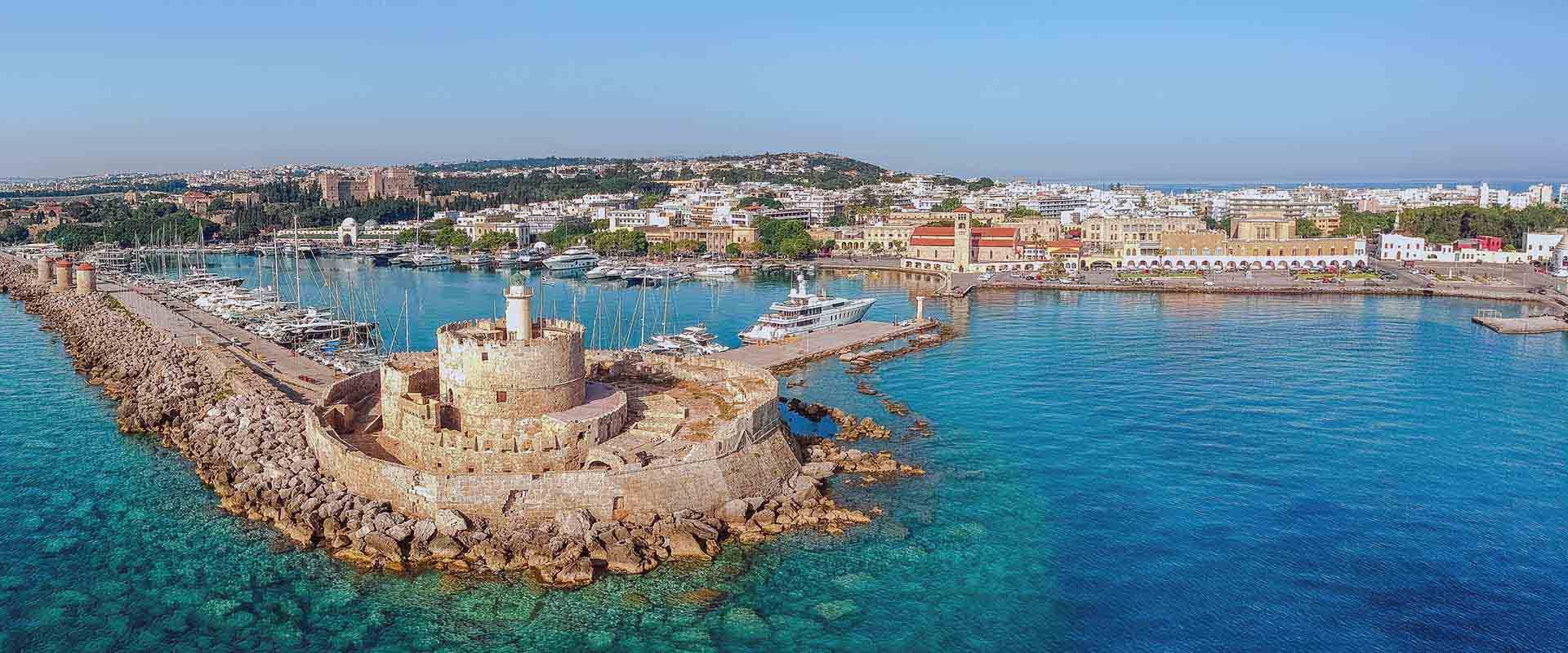
Declared a UNESCO World Heritage Site, the old town of Rhodes is home to a wealth of fascinating and atmospheric architecture from both East and West. The city is split into the old and new town with the old town built inside a castle from the medieval period, making the entrance from the harbor a jaw-dropping sight. The inside of the old town is full of winding streets, local shops, and restaurants, as well as the old market. The Palace of the Grand Master of the Knights is also well worth a visit. Dating back to the 7th Century, this building has an intriguing mix of Byzantine, Greek, and Italian influence, and its museum is also inside. In town, you can find many luxury resorts and, most importantly, Elli Beach, a vast, long sandy beach with plenty of beach bars and sun loungers.

Tsambika Beach

Just shy of a kilometer long, Tsabika is a favorite spot for stopping off on a small ship cruise around Rhodes. The beach is a long stretch of golden sand and the perfect place for sunbathing and enjoying a relaxing meal or drink at the tavernas. There are also several water sports centers where you can rent kayaks and canoes or even try something more adventurous, like water skiing. You can also walk up the hill behind the beach and enjoy a spectacular view and the tiny white chapel of Tsambika monastery, a pilgrimage point for those hoping to improve their fertility.

Faliraki

Packed to the brim with fun, Faliraki Resort doesn't just have a long and beautiful beach and some of the best nightlife in Rhodes. The beach is lined with classy beach bars perfect for a cool drink or lunch in the day and the best spot to party at night. There is also a large waterpark at Faliraki with slides, rafting, and a wave pool to enjoy.

Best Time to Cruise around Rhodes Island

Rhodes is a much-loved destination for people around the world year-round, so while there isn't the best time to visit Rhodes, the seasons offer different experiences. The summer season is the highest for visitors, Rhodes is hugely popular with crowds from many different parts of the world. June to August are the hottest and busiest months, although you will find it easier to escape any crowds staying on a small ship cruise. The island's nightlife is at its wildest at this time of year, and it is a great time to party hard. You should book well in advance if you plan to visit in this time period as small ship cruises are top-rated in the Greek islands in the summer. Outside of the peak season, you can visit Rhodes in May, September, and October and still find long, hot days, although mornings and evenings are a little cooler. This is the perfect time to visit Rhodes if you are more interested in cultural visits as the sites are less busy and the weather more suitable for walking around.

How to Get to Rhodes Island

Some Rhodes cruises depart directly from Athens port and sail over to the island on the first day and night, so you can go straight from the airport using a taxi or transfer or use the metro station beneath the airport. By far, the quickest way to get to Rhodes Island is by flying to Athens airport and taking a connecting flight to Diagoras Airport on the island. Direct flights are available from most major European hubs and several US cities such as New York, Philadelphia, and Newark. If you prefer to take the ferry to Rhodes, the port of Athens has a wide range of boats departing daily. These vary from large cruise liner-size ships to faster, if much smaller, hydrofoils. Be sure to check the itinerary as many of these boats stop off at several islands before arriving in Rhodes, making the journey quite long.

Rhodes Island Cruise Tips

  • If you choose to take the ferry to Rhodes, it is worth planning to arrive a day early before your cruise as the ferries can be slightly unpredictable and in the high season, incredibly full.
  • Rhodes's old and new town is relatively spread out, and many rent bicycles to explore the town thoroughly. This is suitable during the colder off-peak months; however, walking or taking a taxi in summer is best when the temperatures can be scorching hot.
  • Rhodes has a long and historical tradition of winemaking using a Muscat-like grape to create unique flavors. There are several wineries on the island, some of which offer fascinating tours, including tastings.


What to know about adventure cruising in Rhodes

What was the Colossus of Rhodes?

A bronze statue of the sun god Helios, raised beside Rhodes harbor between 292 and 280 BC to celebrate the city's survival of a year-long siege, and counted among the Seven Wonders of the Ancient World. It stood about 33 m (108 ft) tall — roughly two-thirds the height of the Statue of Liberty. Despite the famous illustrations, it did not straddle the harbor entrance: a bronze figure that size could not have stood with its legs apart without collapsing under its own weight.

What happened to the Colossus of Rhodes?

An earthquake in 226 BC snapped it at the knees and brought it down on land after just 54 years of standing. The Rhodians left it where it fell on the advice of the Oracle at Delphi, and the wreckage lay there for more than 800 years as a tourist attraction in its own right — Pliny records visitors marveling at the scale of the fragments. A later, much-doubted account says an Arab force sold the bronze to a merchant in AD 653, who is said to have carried it off on 900 camels; nothing of it has ever been found.

How tall was the Colossus of Rhodes?

Ancient sources give it as 70 cubits, about 33 m (108 ft) from feet to crown, standing on a marble pedestal that added perhaps another 15 m (49 ft). That made it the tallest statue of the ancient world, and it is close in scale to the Statue of Liberty measured the same way — Liberty's figure alone is 46 m (151 ft). Nobody knows exactly where it stood; the harbor mole, the breakwater and the acropolis above the port have all been argued for.

What is there to do in Rhodes?

Rhodes Old Town is the anchor — a UNESCO World Heritage Site since 1988, ringed by roughly 4 km (2.5 mi) of Hospitaller walls with 11 gates, and still home to about 6,000 people. Beyond it, Lindos gives you a Doric temple of Athena from around 300 BC, set within a Crusader fortress, above the near-enclosed cove of St Paul's Bay, 40 km (25 mi) down the east coast. Add the Valley of the Butterflies, the ruins of ancient Kamiros, and a 220 km (137 mi) coastline with beaches on both the sheltered east and the windswept west.

Which are the best beaches in Rhodes?

The east coast is the calm side — Tsambika, Agathi and Anthony Quinn Bay for clear water over rock, Faliraki for the full resort experience, and the sweep below Lindos for shallow swimming. The west coast catches the wind, making Ialysos and Theologos two of the better windsurfing and kitesurfing beaches in the Aegean. At the island's southern tip, Prasonisi is the oddity: a sandspit with the Aegean breaking on one side and the Mediterranean on the other, walkable in summer and submerged in winter.

What is the weather like in Rhodes?

Hot, dry summers and mild winters, with more sunshine than almost anywhere in Europe — Rhodes Airport records 3,180 hours a year, including 391 hours in July alone. July and August average a daily high of about 30.5°C (87°F) with nights around 25°C (77°F); May and October are gentler at roughly 24–26°C (75–79°F). The sea is swimmable from late May, peaking near 27°C (81°F) in August and still around 24°C (75°F) in October.

Where is Rhodes?

Rhodes is the largest of the Dodecanese, in the far southeastern Aegean, 363 km (226 mi) east-southeast of the Greek mainland and only 18 km (11 mi) off the Turkish coast at the nearest point. Rhodes Town, at the island's northern tip, is about 25 nautical miles (46 km / 29 mi) from Marmaris in Turkey — an hour by fast ferry. Athens is roughly an hour away by air, or 15 to 25 hours by overnight ferry from Piraeus.

What is Rhodes known for?

Three things above all: the Colossus, the medieval walled town the Knights Hospitaller built between 1309 and 1523, and a climate that keeps the island open long after the rest of Greece has closed. It is one of the largest and best-preserved inhabited medieval towns in Europe, with the Palace of the Grand Masters, the cobbled Street of the Knights, and a working Ottoman quarter inside the same walls. It is also known for Lindos, the Valley of the Butterflies, and a beach coastline that changes character depending on which side of the island you stand on.

Where do cruise ships dock in Rhodes?

Ships berth alongside in the main commercial harbor — the terminal area is signed variously as the Tourist Port or Kolona, with the adjacent Akandia quay taking ferries and the largest vessels — immediately outside the Old Town walls. It is about a five-minute walk to the nearest medieval gate, the Freedom Gate, with the Marine Gate a little further along. Tenders are not normally needed; small ships sometimes use Mandraki, the old harbor, which is closer still.

What can you do in Rhodes on a one-day cruise stop?

You can walk off the ship straight into the Old Town, which is the rare case where the best sight is at the gangway — allow two to three hours for the Palace of the Grand Masters, the Street of the Knights, and the Archaeological Museum. If you would rather see the island, Lindos is 40 km (25 mi) down the east coast, about 50 minutes by road, and the acropolis climb from the pedestrian-only village takes 10 to 15 minutes. Doing both in one call is tight but feasible on a long port day.

What currency do you use in Rhodes?

The euro. Greece has used it since 2002, and Rhodes is in the EU and the Schengen area, so no currency change is needed anywhere in the Dodecanese. Cards are accepted almost everywhere in Rhodes Town and Lindos, though small tavernas, village kafeneia, and the donkey and boat operators often prefer cash.

How far is Rhodes from Athens?

About 363 km (226 mi) as the crow flies, southeast across the Aegean. Flights from Athens take roughly an hour and run several times daily year-round; the ferry from Piraeus is an overnight passage of 15 to 25 hours depending on the route and the number of island calls. Most cruise itineraries reach Rhodes from Crete, Santorini, or the Turkish coast rather than directly from Athens.

How big is Rhodes?

Rhodes covers 1,401 sq km (541 sq mi), making it the fourth-largest Greek island and the biggest in the Dodecanese by a wide margin. It runs about 80 km (50 mi) from north to south and 38 km (24 mi) across at its widest, with 220 km (137 mi) of coastline and a population of roughly 125,000. Mount Attavyros, at 1,216 m (3,990 ft), is high enough to hold clouds when the coast is clear.

Is Rhodes in Greece or Turkey?

Rhodes is Greek — part of the Dodecanese in the South Aegean Region, formally incorporated into Greece on 7 March 1948 after Italian rule. The confusion is geographic: the island lies just 18 km (11 mi) off the Turkish coast and is far closer to Asia Minor than to mainland Greece, which is 363 km (226 mi) away. You will need a passport and a separate entry for the day ferry to Marmaris, but nothing changes on Rhodes itself.

What was Rhodes in ancient Greece?

A major maritime and commercial power. The city of Rhodes was founded in 408 BC by the union of three older city-states — Ialysos, Kamiros and Lindos — and its fleet and harbor dues made it rich enough to raise the Colossus after surviving the siege of Demetrius in 305–304 BC. It also gave the ancient world a body of maritime law that the Romans later absorbed, and a school of rhetoric that drew Cicero and Julius Caesar.

We’re here to help, 24/7.

Connect with our expert travel consultants to plan your next trip.

  • Juliane Ball
  • Ester Canali
  • Oksana Kovaleva
  • Josue Zarco
  • Andrea Martinez
  • Farah Celada-Benito
  • Nina Kapp