Liveaboard.com

Jellyfish Lake Liveaboard Diving

Our guests rated liveaboard diving in Jellyfish Lake as 8.9

  • 100% Best Price Guarantee

Liveaboard Diving in Jellyfish Lake

What to expect on a Jellyfish Lake liveaboard

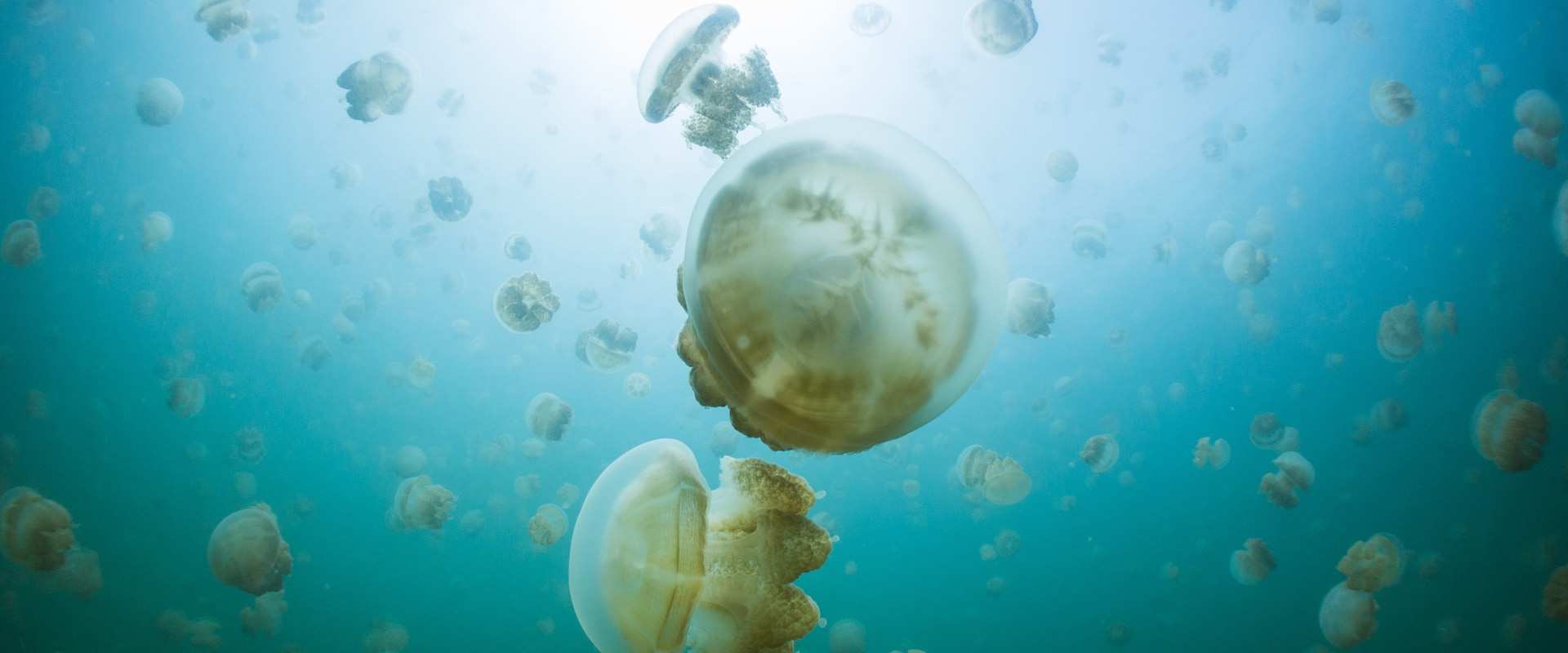
Liveaboards to Jellyfish Lake (known as Ongeim'l Tketail in Palauan) will give you the chance to swim and snorkel with millions of Golden Jellyfish (Mastigias sp.). This lake in Micronesia was formed back in the ice age which cut the lake off from the ocean on the island of Eil Malk or also known as Mecherchor island located in the Rock Islands in the southern lagoon. The lake is one of 70 isolated lakes in this area. The lake is about 2m (6ft) to 6m (18ft) deep, and you should avoid going down to a depth of 15m (45ft) to 20m (60ft) as there is a Hydrogen Sulphide layer around that level. With a lack of current or waves, it is an easy and calm experience on your Jellyfish Lake liveaboard.

What You Can see

Obviously, the first thought with jellyfish is that they sting, but that is what makes this site unique. Due to the lake being isolated, there is no fear of predators for these jellyfish, which is also why there are such a high number of them, but this also means that their stingers no longer sting as there is no threat to them at all. The jellyfish spend their peaceful days following the sun, as the sun attracts the algae on which they feed. Most Jellyfish Lake liveaboards arrive at the lake on a dock situated on the northwest corner, which will give you a good view of this.

This is indeed only a snorkeling and swimming site; no SCUBA is allowed here because it would disrupt the natural ecosystem, and so everyone is welcome to come here. This is because the bubbles of SCUBA divers could get trapped under the head of the jellyfish, push them up to the surface and then the bubbles would go through their membrane and create an injury, something we very much want to avoid. Apart from the swimming in the lake, this island provides you with a beautiful, peaceful, and remote destination in which you can swim, hike, and enjoy being away from the crowds whilst on your Jellyfish Lake cruise.

Getting To Jellyfish Lake

To get to this site, or to get to any Micronesia liveaboards which will be visiting this area, then you will need to make your way to Koror, which is the largest city in Palau. The airport is located on the island of Babeldaob which is connected by a bridge to Koror. The airport is called The Roman Tmetuchl International Airport. There are only five destinations that have outgoing flights to Palau, so you would have to fly to one of these first; Philippines, Taiwan, South Korea, Japan, and Guam. Once in Palau, everything is organized mostly from Koror, most dive shops are located there and any liveaboards will depart from the Malakal Harbour in Koror. You will then be taken to the island of Eil Mak, which is 28km (18mi) from Koror, so about 30min-40min by boat, once there you will take a hike up a steep slope for about 400m (1/4mi) and then you will reach the lake for a nice swim and a unique experience.


Jellyfish Lake Diving Reviews

  • Rating 8.9 out of 10
  • 8.9 Fabulous
  • Rating 8.8 out of 10
  • 8.8 Fabulous
  • Mary K
  • Flag of United StatesUnited States

Did not go; reportedly not many jellyfish there.

Diving Jellyfish Lake in March on the Black Pearl
  • Rating 7.6 out of 10
  • 7.6 Good
  • Mr. Ralph E
  • Flag of United StatesUnited States

Snorkeling was good with water at 90 degrees but sparce golden jellyfish due to recent die-off

Diving Jellyfish Lake in February on the Black Pearl
  • Rating 10.0 out of 10
  • 10.0 Exceptional
  • Karl H
  • Flag of United StatesUnited States

Jellyfish Lake was amazing! It was wonderful to float among thousands of beautiful, stingless jellyfish.

Diving Jellyfish Lake in May on the Black Pearl
  • Rating 10.0 out of 10
  • 10.0 Exceptional
  • Elizabeth W
  • Flag of AustraliaAustralia

So blessed to have experienced this snorkel as population had increased- Bucket list.

Diving Jellyfish Lake in June on the Palau Aggressor II


What to know about diving in Jellyfish Lake

Where is Jellyfish Lake?

Jellyfish Lake sits on Eil Malk Island in Palau's Rock Islands, about a 45-minute to one-hour boat ride south of Koror. It's one of dozens of marine lakes scattered through the Rock Islands, but by far the most visited thanks to its population of harmless golden jellyfish.

What country is famous for Jellyfish Lake?

Palau, in Micronesia, is famous for Jellyfish Lake — one of the nation's signature attractions, alongside Blue Corner and the Rock Islands Southern Lagoon. A similar (less-visited) jellyfish lake exists on Kakaban Island in Indonesia, but Palau's is the one most travelers mean when they use the name.

Can you scuba dive in Jellyfish Lake?

No — scuba diving has been banned in Jellyfish Lake for years because exhaled bubbles can injure the fragile jellyfish, and the water below about 50 ft (15 m) contains hydrogen sulfide that's hazardous to breathe. Only snorkeling with a mask and fins is permitted, and swimmers are asked to avoid touching the jellyfish altogether.

Can you snorkel in Jellyfish Lake?

Yes — snorkeling is the only way visitors are allowed to experience the lake, and it's included on most Rock Islands day tours from Koror. A short, sometimes steep 10-minute walk over a limestone ridge gets you from the boat dock to the lake itself.

Do the jellyfish in Jellyfish Lake sting?

The golden jellyfish here have lost most of their sting through evolving in an isolated lake without natural predators, so most visitors feel nothing more than a faint tingle, if anything at all. A related population of moon jellyfish in the same lake retains a very mild sting, though it's rarely noticeable to swimmers.

How deep is Jellyfish Lake?

The lake reaches about 100 ft (30 m) deep, but only the top 30–50 ft (9–15 m) contains oxygen and supports life; below that, hydrogen sulfide makes the water toxic. Snorkelers stay entirely within that upper, jellyfish-filled layer.

How do you get to Jellyfish Lake?

Most visitors reach it as part of a Rock Islands day tour by boat from Koror, roughly 45 minutes to an hour depending on the operator, followed by a short but sometimes slippery limestone trail to the lake's edge. It's rarely visited as a standalone trip since it's usually bundled with stops at other Rock Islands sites.

How much does it cost to visit Jellyfish Lake?

As of 2026, a Jellyfish Lake permit costs $100 per person (ages 6 and up) and is valid for five days, on top of the standard $50 Rock Islands Permit required for the wider Rock Islands Southern Lagoon area. Most tour operators bundle these fees into their day-trip pricing.

What is the best time of day to visit Jellyfish Lake?

Mid-morning, around 9–11 a.m., is generally considered the best window for sunlight to penetrate the water and for jellyfish to rise closer to the surface. Arriving before the bulk of day-tour boats also means a quieter, less crowded swim.

How many jellyfish are in Jellyfish Lake?

Numbers have declined sharply from the millions the lake was once famous for — recent counts have put the golden jellyfish population at under 6,000, alongside a healthier population of moon jellyfish. Researchers attribute the drop to warming water and changing rainfall patterns rather than any single event.

What kind of jellyfish live in Jellyfish Lake?

The lake's namesake golden jellyfish (a locally evolved population related to spotted jellyfish) shares the water with a smaller population of moon jellyfish. Both species have adapted to the lake's isolated conditions over thousands of years since it separated from the open ocean.

Is Jellyfish Lake worth visiting?

For most travelers, yes — snorkeling among thousands of gently pulsing, essentially stingless jellyfish is a genuinely unusual experience unavailable almost anywhere else. Just set expectations: numbers are lower than the lake's famous photos from decades past, and it's best paired with other Rock Islands stops rather than visited alone.

We’re here to help, 24/7.

Connect with our expert travel consultants to plan your next trip.

  • Oksana Kovaleva
  • Nina Kapp
  • Nicole Laughlin
  • Juliane Ball
  • Farah Celada-Benito
  • Mylene Issartial
  • Ester Canali