Liveaboard.com

Andaman Sea Liveaboard Diving

Our guests rated liveaboard diving in Andaman Sea as 9.0

  • 100% Best Price Guarantee

Liveaboard Diving in Andaman Sea

What to  Expect on an Andaman Sea Liveaboard

Liveaboards to the Andaman Sea take divers to one of the top dive destinations in the world. With a tropical island backdrop, the Andaman Sea offers an impressive underwater topography mixed with diverse marine life, claiming some of the best diving in Thailand and worldwide. The unique diversity of the dive sites (suitable for different levels) on an Andaman Sea liveaboard promises vastly different diving experiences. Liveaboard.com offers a wide range of liveaboards in the Andaman Sea, Thailand, some with unique attributes tailored to your needs.

Andaman Sea Underwater

Divers on an Andaman Sea liveaboard can expect a range of topography, from soft corals and sea fans to hard corals, deep drop-offs, massive underwater boulders, swim-throughs, caves, and more. Dives with manta rays, eagle rays, sea turtles, sharks, pipefish, barracuda, catfish, and schools of reef fish are standard practice, with the occasional presence of the graceful whale shark in season. Water conditions present mild to strong currents, good visibility, and warm temperatures.

Dive Sites/Areas of the Andaman Sea

Andaman Sea Liveaboard itineraries may vary, but the most popular dive sites/areas include:

KOH LANTA is rated as one of the best dive areas in Thailand, hosting two popular dive sites: Hin Daeng & Hin Muang. Renowned for their beautiful pink and purple soft corals giving them their name, the topography is simple yet intricate, with Thailand's biggest vertical wall, outcrops, ledges, small inlets, canyon-like formations, and rocky bays. Adding to the terrain is the incredible marine life of whale sharks, manta rays, and grey reef sharks, which are the creme de la creme. Visibility is often up to 25m unless the waters are plankton-rich.

SURIN ISLANDS offer regular sightings of cruising white tip reef sharks, barracuda, batfish, ghost pipefish, bumphead parrotfish, napoleon wrasse, octopus, mantis shrimp, blue-spotted jawfish and the rarer sightings of seahorses, frogfish, manta rays and whale shark. Depths range from 5 to 30 meters with warm, clear waters; the coral formations in these waters act as a good barrier, with fields of staghorn corals dominating the shallows. You may see the occasional passing eagle rays in the blue.

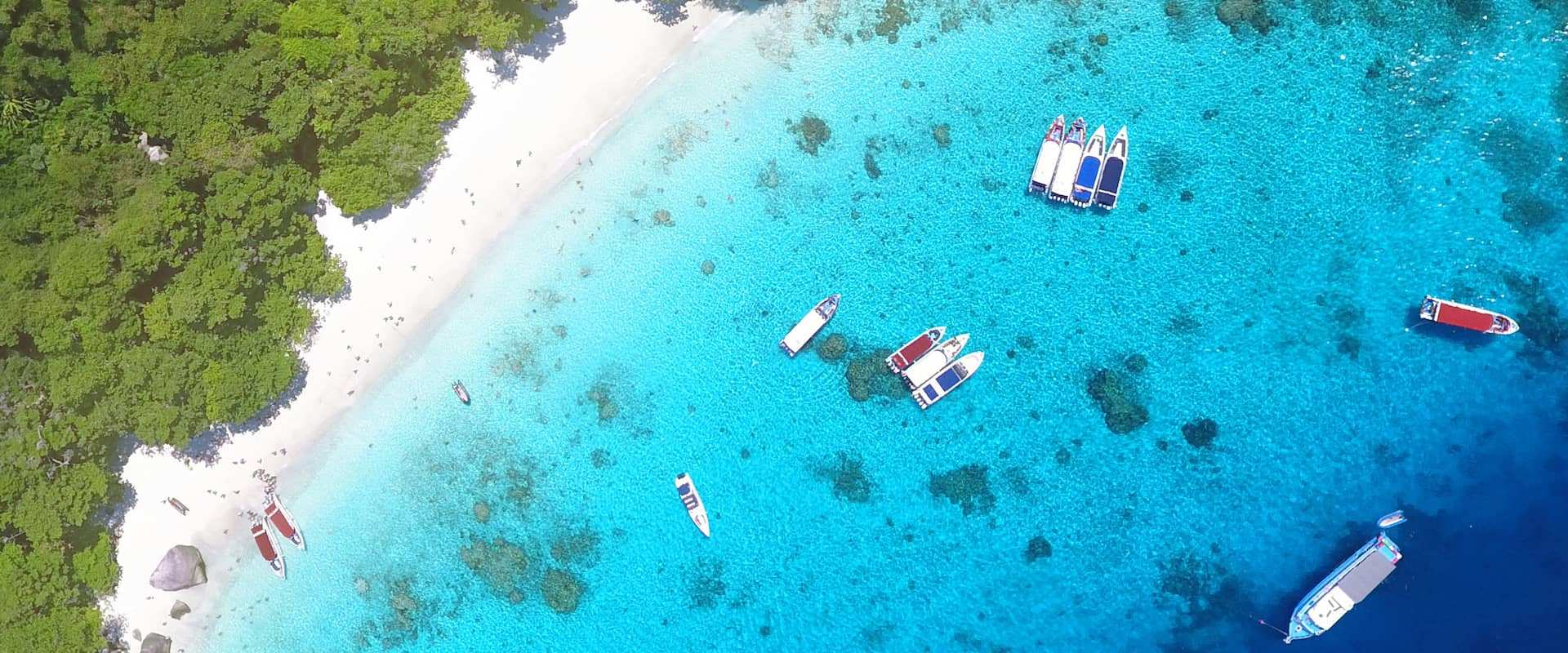
SIMILAN ISLANDS are possibly the most popular dive destination in Thailand. White sandy beaches, granite boulders above and below water, and vibrant reefs all create an exceptional diving landscape topped with a plethora of marine life. A variety of dive sites home to over 500 species, to name a few: leopard sharks, guitar rays, whitetip sharks, blue-spotted stingrays, clown triggerfish, rabbitfish, scorpionfish, snappers, emperor fish, giant trevally, and angelfish. Macro lovers will enjoy finding tiny ghost pipefish, mantis shrimps, porcelain crabs, cleaner shrimp, and more.

RICHELIEU ROCK, to the southeast of the Surin Islands, is renowned for whale shark sightings and other pelagics like the Manta Ray, barracuda, giant trevallies, and dogtooth tuna. This site also provides a plethora of critters, including porcelain crabs, tiger tail sea horses, pipefish, harlequin shrimp, and nudibranchs.

KOH TACHAI is located northwest of Similan Islands National Park. This site is tailored to the more advanced diver, with drop-offs up to 70m, swim-throughs, and strong currents. In February and April, whale sharks and manta rays feed on plankton in the waters. Common sightings include leopard sharks, Napoleon wrasse, Hawksbill turtles, groups of batfish, banded sea snakes, barracudas, trevallies, and sharks.

KOH BON, south of Surin Island, is known as the perforated island, classified as a deep dive due to a fantastic wall dive that goes down to 42m on the southwest side. Also frequented by many leopard sharks, the usual suspects such as the morays and white tip reef sharks cohabit these waters. Also a popular cave diving spot, this should only be attempted with the right certifications.

Top Tips for Divers

There are many dive areas in the Andaman Sea, so you can dive in different locations depending on the time of year. Liveaboard trips to the more remote areas in the Andaman Sea, such as the Similans, Richelieu Rock, and Hin Daeng, only run from November through to May due to weather conditions making these inaccessible. The best time to dive in these sites is the end of February when an increase in currents attracts larger marine creatures like whale sharks and manta rays. Visibility ranges from 25-40m during this period, and water temperatures range between 28-31C. Some dive areas are tailored for the more advanced diver, so it may be better to check with your Liveaboard cruise what dive experience you need before deciding on your itinerary. It is possible to rent equipment on most cruises, however, as most divers know, it is always recommended to have your own gear. If you bring your own equipment, bring a DIN adapter, as Thailand uses the standard yoke system. You may not need more than a 3mm neoprene shorty or full body wetsuit bearing in mind after 3 or more dives a day, you may get cold.

Most dive sites offer fantastic opportunities for avid underwater photographers, so remember to bring your camera and battery charger! Some Liveaboards cater to specific languages, so it may be worth checking before booking if you are more comfortable in a language other than English.

The currency is the Thai Baht, but it is recommended that you also take US dollars. The electricity voltage runs at 220 volts, and it is recommended that you bring a universal adapter.

The nearest recompression chamber is in Phuket.

Getting to the Andaman Sea

Thailand liveaboards that cruise the Andaman Sea may depart from different ports, usually Chalong Pier in Phuket or Thap Lamu Pier in Khao Lak, Phang-Nga Province. Transfers to the port are provided from Phuket International Airport or your hotel. Please note that some liveaboards may even depart from one port and return to another, i.e., depart from Phuket and return to Khao Lak. Some International flights fly directly to Phuket, or you can get a connecting flight from Bangkok. You can reach Khao Lak overland from Phuket.


Andaman Sea Diving Reviews

  • Rating 9.0 out of 10
  • 9.0 Superb
  • Rating 10.0 out of 10
  • 10.0 Exceptional
  • Bradley F
  • Flag of United StatesUnited States

We were diving off season during the rainy period, so visibility was low on most of our dives. The day we spent where the islands and open sea beautiful visibility that’s the best diving we had No room for complaint as I knew what season I was diving in

Diving Andaman Sea in July on the Seatopia
  • Rating 10.0 out of 10
  • 10.0 Exceptional
  • Brian H
  • Flag of United StatesUnited States

Amazed by the variety of coral and animals we saw. Never felt any danger or anxiety as our dive guides knew where to go and always monitored our air/nox.

Diving Andaman Sea in September on the Seatopia
  • Rating 8.0 out of 10
  • 8.0 Very good
  • Andrew F
  • Flag of United StatesUnited States

Very nice overall - great life and healthy reefs.

Diving Andaman Sea in December on the Sawasdee Fasai
  • Rating 9.6 out of 10
  • 9.6 Exceptional
  • William Q
  • Flag of United StatesUnited States

Visibility was OK. Some sites had a bit of current while diving.

Diving Andaman Sea in January on the Sawasdee Fasai


What to know about diving in Andaman Sea

Where is the Andaman Sea located?

The Andaman Sea lies in the northeastern Indian Ocean, bordered by Myanmar and Thailand to the north and east, Malaysia and Indonesia to the south, and India's Andaman and Nicobar Islands to the west. Thailand's dive hubs of Phuket and Khao Lak sit right on its eastern shore, making it the launch point for liveaboards to the Similan and Surin Islands.

How deep is the Andaman Sea?

Depths vary widely — shallower shelf areas near river mouths run less than 590 ft (180 m), while the central and western basins drop to 3,000–9,800 ft (900–3,000 m), and submarine valleys near the Andaman-Nicobar Ridge exceed 13,000 ft (4,000 m). The reefs and pinnacles divers actually visit, like Richelieu Rock and Koh Bon, sit in a much shallower band of roughly 16–130 ft (5–40 m).

Is the Andaman Sea dangerous?

Not for divers following standard precautions — the main hazards are strong currents at exposed pinnacles, occasional monsoon swells outside the November–April dive season, and the usual open-water considerations rather than anything unique to the region. Liveaboard crews plan routes and dive sites around conditions, and most Andaman Sea sites are well within recreational and advanced recreational limits.

What countries border the Andaman Sea?

Myanmar, Thailand, Malaysia, and Indonesia border the Andaman Sea along the mainland and peninsula side, while India's Andaman and Nicobar Islands form its western edge. Thailand's stretch of coastline is the one liveaboard divers know best, since it's home to the Similan and Surin Islands and Richelieu Rock.

What is the water temperature in the Andaman Sea?

Water temperature typically runs 82–86°F (28–30°C) during the November–April dive season, warm enough for most divers to get by with a 3mm wetsuit or even a rash guard. It can dip a few degrees cooler at depth around exposed pinnacles like Richelieu Rock and Hin Daeng.

What is the visibility like when diving the Andaman Sea?

Visibility generally ranges from 50–100 ft (15–30 m) in high season, often at its clearest from February through April, before the pre-monsoon haze builds. It can drop noticeably during plankton blooms that, ironically, also draw in whale sharks and manta rays.

When is the best time to dive the Andaman Sea?

November through April is the season, with calm seas, good visibility, and the national parks open; February through April is the peak window for manta ray and whale shark encounters at sites like Richelieu Rock and Koh Bon. The Andaman Sea's west-coast liveaboard season shuts down entirely from mid-May to mid-October for the southwest monsoon.

Is the Andaman Sea part of the Indian Ocean?

Yes — it's a marginal sea of the northeastern Indian Ocean, separated from the open ocean by the Andaman and Nicobar Islands. That geography is part of why it funnels such nutrient-rich water past Thailand's dive sites.

What marine life can you see diving the Andaman Sea?

Expect manta rays and whale sharks (especially February–April), leopard sharks, reef sharks, and enormous schools of barracuda and trevally at current-swept pinnacles, plus a colorful reef community of nudibranchs, seahorses, and hard and soft coral. Richelieu Rock and Hin Daeng/Hin Muang are considered the region's marquee big-animal sites.

How rough are the currents in the Andaman Sea?

Currents can run strong at exposed pinnacles like Koh Bon Pinnacle and Richelieu Rock, which is part of why many of the best sites are recommended for divers with some experience. Sheltered ridge and bay sites nearby offer calmer alternatives on the same itinerary.

How long is a liveaboard trip on the Andaman Sea?

Most Andaman Sea liveaboards run 3 to 7 nights out of Khao Lak or Phuket, covering the Similan and Surin Islands, Koh Bon, Koh Tachai, and Richelieu Rock, with longer trips sometimes adding Hin Daeng and Hin Muang to the south. Day-trip boats also cover closer sites for travelers without the extra days.

What's the difference between diving the Andaman Sea and the Gulf of Thailand?

The Andaman Sea, on Thailand's west coast, has the country's most dramatic topography — granite pinnacles, walls, and strong currents that draw big pelagics — while the Gulf of Thailand around Koh Tao is calmer, shallower, and better suited to beginners and certification courses. Many divers do a course in the Gulf, then head to the Andaman side for more advanced sites.

Why is it called the Andaman Sea?

The sea takes its name from the Andaman Islands, India's westernmost boundary of the basin, whose own name is thought to derive from "Andaman," a Malay rendering of Hanuman, the monkey deity of Hindu mythology. The name has stuck through centuries of regional trade and naval charting.

Is the Andaman Sea affected by monsoons?

Yes — the southwest monsoon from roughly May to October brings rough seas, poor visibility, and the closure of Thailand's Similan and Surin national parks, shutting down west-coast liveaboard diving for the season. The northeast monsoon months of November through April are calmer and make up the main dive season.

How far offshore are the best Andaman Sea dive sites?

Richelieu Rock sits about 45 miles (70 km) from Khao Lak, while the Similan Islands are roughly 40 miles (65 km) offshore — far enough that day trips run long and multi-day liveaboards are the more comfortable way to reach them all. Koh Bon and Koh Tachai sit between the mainland and the outer islands, making them common first or last stops on an itinerary.

We’re here to help, 24/7.

Connect with our expert travel consultants to plan your next trip.

  • Andrea Martinez
  • Oksana Kovaleva
  • Josue Zarco
  • Farah Celada-Benito
  • Juliane Ball
  • Mylene Issartial
  • Nina Kapp