Liveaboard.com

Darwin Island Liveaboard Diving

Our guests rated liveaboard diving in Darwin Island as 9.0

  • 100% Best Price Guarantee

Liveaboard Diving in Darwin Island

What to expect on a Darwin Island Liveaboard

Named after the famous evolutionary biologist Charles Darwin, Darwin Island, and Darwin's pillars, now unfortunately collapsed, is the most Northerly and remote outcrops of the Galapagos. They sit 40 km / 25 miles north of Wolf Island on the same mid-ocean ridge, making the bottom topography and current streams special around the islands. Darwin is incredibly small, only 1 km / 0.5 mile above water.

The island feels very remote and special when you are there, with your only company being the Galapagos National Park patrol and research boats. Land visits to Darwin and Darwin's Pillars are prohibited, and only a few liveaboard dive boats visit here. The underwater life is spectacular, with an unbelievable number of hammerhead sharks, tuna, silkies, and turtles, and chances to see tiger and whale sharks.

On the island and the pillars, you can see red-footed boobies, vampire finch, and fur seals. The waters around the island are highly protected due to the number of sharks and other large pelagics at risk from illegal fishing. Darwin Island is also a common location for the Galapagos National Park to tag hammerheads and whale sharks passing on the ocean currents.

Daily Schedule

Morning

The day will start early with two morning dives with breakfast in between. After the briefing, you will be dropped by panga tender around Darwin's pillars. All the dives will be done around the pillars, and where you are dropped will depend greatly on the surface conditions and the current.

With high swell and strong currents, Darwin's pillars are not for the faint-hearted but stunning. The waters are thick with sharks, rays, and tuna, and during the whale shark season, this is your best chance to dive with the giants. Dives normally last around 50-60 minutes, and the aquatic show is so spectacular you might find the time seems to go very quickly.

Afternoon

If conditions permit, you will have another two dives at Darwin. After lunch, everyone will be straight down to the dive deck, itching to get back in the water. Although there is technically only one dive site at Darwin, you will find that the different routes taken by the guides will give you a new experience each time. The pangas will drop you on a different side of the pillars and pick you up after your safety stops, which, with this many sharks and pelagics, will no doubt be in the blue.

Evening

If the conditions are very good in the evening, the boat might anchor in the island's shelter, but it will likely return to Wolf Island for the night. If you sit up on the deck, there will be a chance to see dolphins and sea birds, or you can enjoy looking over your endless shark videos instead!

Darwin Island Underwater

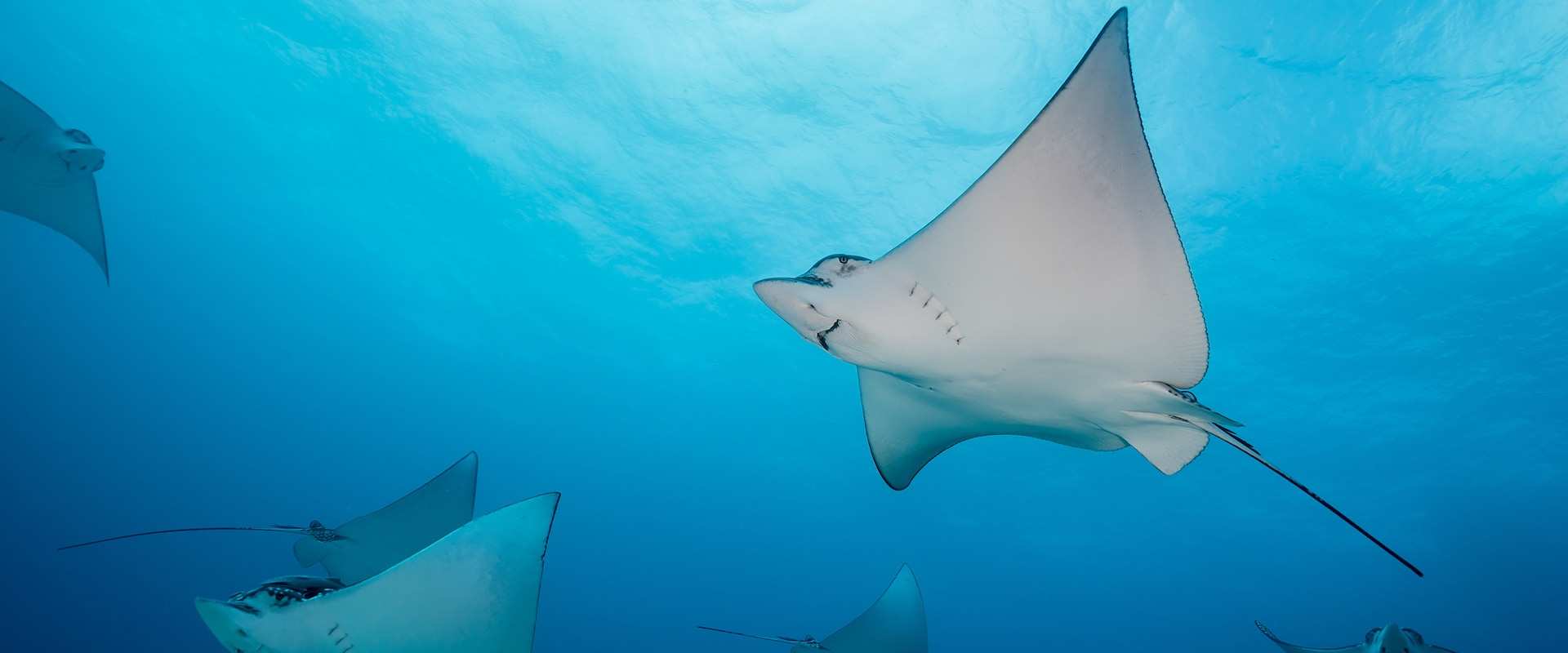
Darwin Island is one of those places where you can see anything! All the aquatic life you would feel lucky to encounter anywhere else is abundant here. The current channels around Darwin are like a pelagic highway at rush hour. The rock reef and plateau at Darwin are a viewing platform to see endless schools of sharks and rays of all sizes. Hammerhead juveniles are particularly curious, and the chances of a close encounter are good. Down on the sandy bottom is your chance to see hammerhead pups. Larger hammerheads carefully guard them and will shy away if approached.

Galapagos sharks are also around, and who knew there could be so many turtles in one place? During the season, you have a good chance of seeing whale and tiger sharks here, so keep a keen eye out for those spots and stripes. As if all that wasn’t enough, you can meet passing dolphins, sea lions, and even the occasional orca whale. Be aware the first sign of orcas is the sudden disappearance of all the other aquatic life. Most of the dives are between 10 and 25 meters, making Nitrox essential to make the most of your time with the sharks.

Top Tips for Darwin Island

  • The conditions at Darwin are rough, so be prepared for a negative entry from the panga.
  • Gloves are an absolute necessity, the current here his phenomenal and the barnacles are sharp.
  • Your 3-minute safety stop should be in the blue if at all possible, it is your chance to really get in the thick of the shark schools and maybe spot a whale shark too.
  • Stay close to your buddy and the group. The current here is not to be underestimated, and it is easy to get distracted by the marine life. You may even have to wedge yourself into the rocks to stop it from drifting.

Getting to Darwin Island

Most Galapagos liveaboards stop at Wolf before sailing to Darwin, although this depends on sea conditions. Darwin is very exposed to the elements, but liveaboards can shelter behind the island at anchor. The sail is only 40 km, but it can be a spectacular journey if you keep an eye out to sea. Pods of dolphins, sometimes breaching rays, and numerous sea birds can be seen from the deck. Divers will always be dropped at Darwin's pillars by panga tender, and it can be a wild ride with high swell and wind waves, which is the norm.


Darwin Island Diving Reviews

  • Rating 9.0 out of 10
  • 9.0 Superb
  • Rating 8.8 out of 10
  • 8.8 Fabulous
  • Justin H
  • Flag of United StatesUnited States

Whale sharks, turtles, hammerheads, tuna and more. Darwin will be a forever memory.

Diving Darwin Island in August on the Galapagos Sky
  • Rating 9.2 out of 10
  • 9.2 Superb
  • Benjamin M
  • Flag of United StatesUnited States

Good dives but not as exceptional as expected - Wolf proved to be a much better set of dives given the conditions. The highlight was four straight dives of seeing a whale shark.

Diving Darwin Island in July on the Galapagos Aggressor III
  • Rating 9.6 out of 10
  • 9.6 Exceptional
  • David G
  • Flag of United StatesUnited States

Darwin pillars, Galapagos sharks and hammerhead sharks were the stars here.

Diving Darwin Island in February on the Humboldt Explorer
  • Rating 7.6 out of 10
  • 7.6 Good
  • Julie R
  • Flag of United StatesUnited States

Visibility wasn't great here, but the guides recognized that and cut our time here short. We did see dolphins under water here, which was a cool experience.

Diving Darwin Island in February on the Calipso Dive


What to know about diving in Darwin Island

Which islands did Charles Darwin actually visit in the Galapagos?

Despite the name, Charles Darwin never set foot on Darwin Island — during his 1835 visit aboard HMS Beagle, he actually explored San Cristóbal, Floreana, Isabela, and Santiago. Darwin Island, in the remote north, was named in his honor later, making it one of the Galapagos' most famous examples of a place named after someone who never visited.

Where is Darwin Island located?

Darwin Island sits in the far north of the Galapagos archipelago, close to Wolf Island and well separated from the central islands most tourists visit. It's remote enough that it's only reachable by multi-day liveaboard, with no day-trip option from the main towns.

What is Darwin's Arch?

Darwin's Arch was a natural rock archway just off Darwin Island that served as the area's most iconic dive site landmark until it collapsed into the sea on May 17, 2021. The underwater terrain and diving remain unchanged — the site, sometimes now called "Darwin's Towers" after its two remaining pillars, is still considered world-class.

Can you still dive Darwin's Arch after the collapse?

Yes — although the above-water arch collapsed in 2021, the underwater topography that made the site famous is intact, and diving there continues to draw divers from around the world. The name "Darwin's Arch" has stuck even though the arch itself is gone.

Why is Darwin Island famous among divers?

It's considered one of the best shark dives on Earth, with walls of 50 to 200-plus hammerhead sharks gliding past divers on a fairly reliable basis, plus seasonal whale sharks, Galápagos sharks, and silky sharks. Few places anywhere combine this density and variety of large sharks in open water.

When is the best time to see whale sharks at Darwin Island?

July through October is the prime window when large, often pregnant, whale sharks cruise slowly through the blue near Darwin. Outside this period, sightings become less predictable, though hammerheads remain a reliable draw year-round.

How strong are the currents at Darwin Island?

Currents can be strong and are often stronger than they appear from the surface, which is why divers are trained to drift with the current rather than fight it. Guides brief closely on current direction and safety procedures before every dive.

What certification do you need to dive Darwin Island?

Most operators require Advanced Open Water certification plus meaningful experience, often around 50 to 100 logged dives, along with comfort in blue-water environments and strong currents. It's not a site recommended for newer divers.

Can you land on Darwin Island?

No — Darwin Island has no designated visitor sites and isn't a landing destination; it's purely a dive and snorkel location reached by boat. All the activity here happens in the water, not on shore.

How do you get to Darwin Island?

The only way to reach it is by multi-day liveaboard cruise, since it sits far north of the central islands and well outside the range of any day-trip boat. Most itineraries pair it with nearby Wolf Island as the trip's signature "northern islands" leg.

What is the water temperature at Darwin Island?

Temperatures vary by season, running roughly 60–75°F (16–24°C), with the cooler end during the June-to-October hammerhead season and warmer water from December to May. Many divers wear a 5–7mm wetsuit even during the warmer months, given the current-driven chill.

Are hammerhead sharks dangerous to divers at Darwin Island?

No — scalloped hammerhead sharks seen in Darwin are generally not aggressive toward divers and typically school in large numbers while showing little interest in people nearby. The bigger practical concerns at the site are the strong currents, not the sharks.

How many dives does a typical Darwin Island liveaboard include?

Itineraries usually schedule two to four dives at Darwin over one or two days as part of a longer Galapagos liveaboard route, often paired with a similar number at Wolf Island. Weather and sea conditions can affect the exact schedule.

Is Darwin Island suitable for underwater photography?

Yes, especially for wide-angle shark photography, given the reliable hammerhead schools and open blue-water visibility. Strong current can make stable shots challenging, so many photographers use a reef hook or careful buoyancy control to hold position.

Why was Darwin Island named after Charles Darwin if he never visited it?

The island was named in recognition of Darwin's broader contribution to understanding the Galapagos' unique evolution, not because he personally explored it. It's a common pattern in exploration history — places honoring a famous naturalist's legacy rather than marking an actual visit.

We’re here to help, 24/7.

Connect with our expert travel consultants to plan your next trip.

  • Oksana Kovaleva
  • Nicole Laughlin
  • Josue Zarco
  • Andrea Martinez
  • Nina Kapp
  • Farah Celada-Benito
  • Juliane Ball