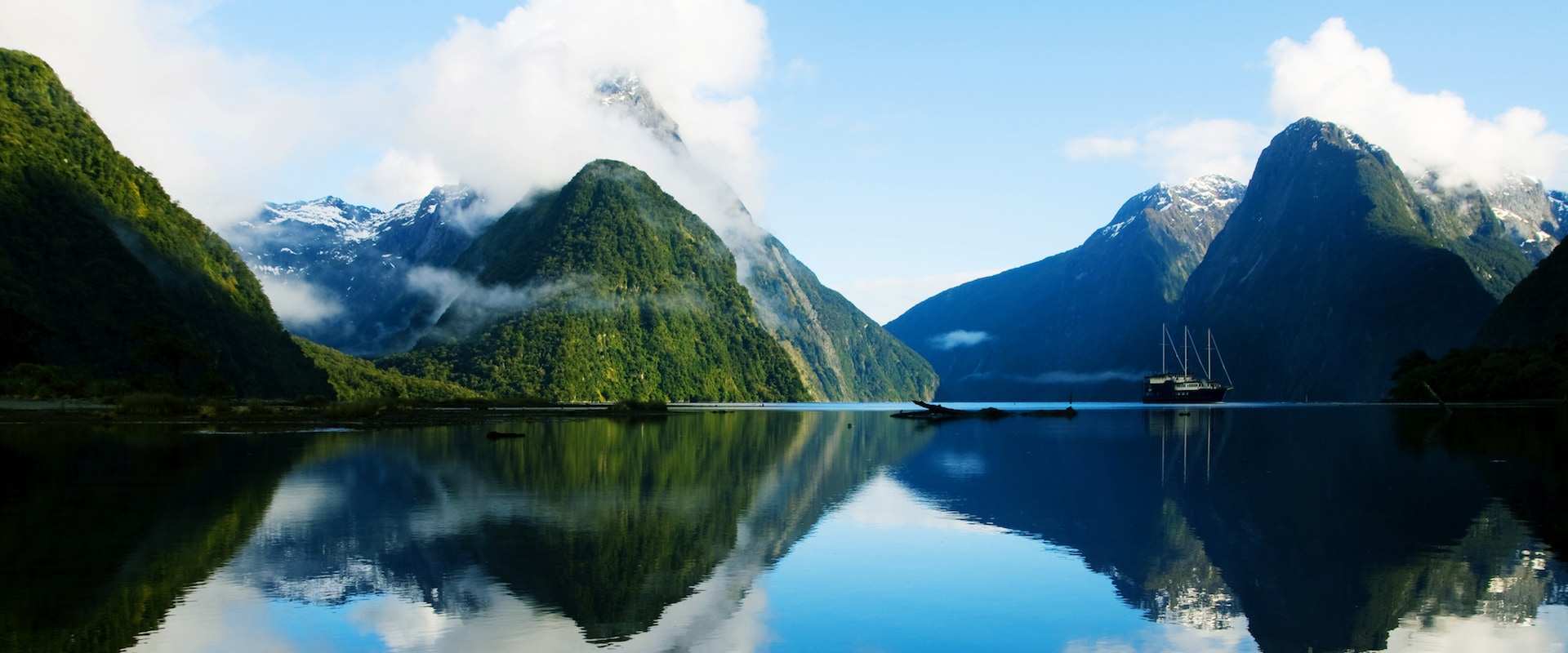
Fiordland Cruises - The fourteen glacier-carved, mountain-rimmed canyons in Fiordland National Park are unbelievably dramatic. This park, and the greater Te Wahipounamu World Heritage area in the southwest corner of New Zealand’s South Island, are a world-renowned scenic destination.
Milford Sound - This most famous New Zealand fiord has been called the world's most popular tourist destination! The sheer rock faces and snowy peaks along Milford Sound gleam with impromptu waterfalls after rainstorms, and even in dry spells, the fiord maintains permanent falls which will dwarf your ship. Albatrosses and dolphins are reasonably common; whale sightings are rare but possible. Walking through the verdant forests onshore is a highlight of Fiordland cruises.
Doubtful Sound - If you enter Doubtful Sound while you’re small-ship cruising around New Zealand, you’ll realize it’s immense, even compared to Milford. Doubtful Sound is a fiord with no fewer than three arms, and five bodies of water which join together at its Pacific outlet. It holds multiple islands, and as far as waterfalls go, Doubtful Sound has one that’s 600 meters tall.
Dusky Sound - One of the largest fiords, Dusky Sound offers islands (some with historic houses and sites), dolphins, seals, occasionally whales, and yellow-eyed penguins. Like its sisters, Dusky Sound sprouts hundreds of waterfalls during the rainy season.
Marlborough Sounds – At the north end of New Zealand’s South Island lies a stunning network of submerged valleys called the Marlborough Sounds. The coastline in this area is incredibly indented, making it perfect for small-ship cruising, kayaking, and walking. It’s the sunniest province of New Zealand, great for visitors who like to soak up rays on deck. It’s also home to the increasingly rare New Zealand King Cormorant (also known as a King Shag) and plenty of other wildlife.
Subantarctic Islands
New Zealand is one of the countries lucky enough to lie within exploration distance of the great Southern Ocean, which encircles Antarctica. Cruising the Subantarctic Islands is one highlight of this proximity. This collection of six island groups claims a natural heritage so special that human impact, including tourism, is tightly regulated.
Macquarie Island - New Zealand boat cruises reliably deliver incredible sights at Macquarie Island, the westernmost of the Subantarctic Islands. Royal Penguins, notable for their long, yellow eyebrows, are endemic here, as are Macquarie Island Shags (kingfishers). The island hosts a colony of massive Elephant Seals (the larger of the two Elephant Seal species). King, Rockhopper, and Gentoo Penguins, multiple albatross species, Orcas, and Southern Right Whales are among the other wildlife you may observe.
Auckland Islands – Adventure cruises visiting the Auckland Islands to the south of New Zealand get to experience a wild, windy land where thousands of birds and a large population of sea lions feel right at home. Human history on the island is colorful, marked by failed settlement attempts, buried treasure, and shipwrecks. The landscape includes fjords and beaches.
The Snares - The cliff-faced Snares island group near New Zealand’s southern tip are completely off-limits to tourist landings in order to protect the local bird population’s breeding grounds. New Zealand cruises stop by to see the endemic Snares Crested Penguin, a vulnerable species, Sooty Shearwaters, the Snares Island Tomtit, and New Zealand Fur Seals.
Campbell Island - Small ship cruising around New Zealand’s Subantarctic Islands may include this ancient, eroded volcano, with breeding Yellow-eyed Penguins and the critically endangered Campbell Teal (a flightless, duck-like bird long believed extinct). Huge Giant Petrels and Southern Royal Albatross are also found here, along with the diminutive Subantarctic Snipe, whose call is wildly disproportionate to its size. Flora on Campbell is equally special, with a variety of unique “mega-herbs,” or huge wildflowers.
Bounty Islands and Antipodes Islands - Off to the southeast of New Zealand’s southern tip, Bounty Island exhibits a grim, rocky landscape, but wildlife thrives- thousands of sea birds breed here, including endemic Erect Crested Penguins, and Salvins Albatross. On the nearby Antipodes Islands, endemic animals include the Antipodean Snipe, Antipodes Island Parakeet (an exceedingly rare creature), and the Antipodean Albatross.
Stewart Island - Over seventy-five percent of Stewart Island, off the tip of New Zealand’s southern point, is protected, and less than five percent is inhabited by humans. You and your ship will be the lone visitors to sweeping beaches and verdant rainforest, with only dolphins, sea birds, land birds, and the aurora australis (southern lights) for company.
Best time to cruise in New Zealand
New Zealand cruises run almost year-round, but to different destinations at different times. If the Subantarctic Islands are your goal, visit New Zealand in November, December, or January. Other summer cruise options are the Bay of Islands (in December) and Fiordland (from January through March).
The Marlborough Sound cruise season extends later into the year (November through April) because the local weather is sunny and warm, and cruising Stewart Island is even possible in May. One thing to note: some operators offer Fiordland cruises during winter (June through August) when seasonal rains feed the waterfalls, and mist makes the landscape evocative beyond belief.
Getting to New Zealand
It’s easy to reach New Zealand from abroad, but exactly which international airport you use depends on your cruise destination. For Bay of Islands cruises, you can simply fly into Auckland on the North Island. If you’re going to Marlborough, Wellington is a great option, though Auckland and Christchurch may work too. (It depends on which local airport you want to reach- see below.)
For Fiordland, Stewart Island, and the Subantarctic Islands, Queenstown is the most convenient international airport. However, Queenstown receives few international airlines, and its direct flights come mostly from Australia. If you’re not coming from Australia, fly first to Auckland, Wellington, or Christchurch- it’s easy to hop on a domestic flight from these airports to Queenstown.
Where New Zealand cruises depart from
Bay of Islands cruises depart from Opua Wharf or Auckland. Your operator will likely arrange transport from the airport if Auckland is your port of departure. If you need to get to Opua Wharf yourself, you can take one of the daily departures on New Zealand’s bus lines or fly to Kerikeri airport in the Bay of Islands area.
Marlborough Sounds cruises depart from Picton or Havelock. To get to Picton or Havelock, you can fly into Blenheim from Auckland, Wellington or Christchurch and take a local shuttle or bus. Alternatively, fly into Picton itself (but only Wellington Airport connects with Picton Airport, so you’ll have fewer choices).
Fiordland cruises depart from Te Anau or Manapouri. Get to these locations by bus or plane from Queenstown. Your cruise may include charter flights or helicopter rides to, from, and among small Fiordland airports.
Subantarctic Islands and Stewart Island cruises depart from the port of Bluff near Invercargill. You’ll need to fly from Wellington or Christchurch to Invercargill, then take a bus or drive to Bluff. If your cruise departs from Stewart Island itself, you can take a public ferry from Bluff to Stewart.
New Zealand Cruise Tips
- Choosing the right trip - New Zealand is famous for the sheer variety of natural habitats and landscapes it holds within its borders. Make sure you research the sights and activities of each cruise destination before you pick, since each locale will be wildly different from the others.
- What to pack - You will benefit from packing for a wide range of activities, temperatures, and weather conditions. Rain gear, walking shoes, a windbreaker, warm underclothes, and swimwear are a good start. In terms of tech, invest in a great camera and binoculars. Consider bringing your own snorkel, mask, and fins if snorkeling or diving is offered.
- New Zealand Travel Advice - Passengers on flights to New Zealand are all subject to advance passenger screening, wherein you’re not allowed to board unless you have the correct entry allowance for your citizenship. Citizens and some residents of the UK and Australia can enter New Zealand without a visa for at least 6 months. Otherwise, you will need to apply for a New Zealand visa in advance.